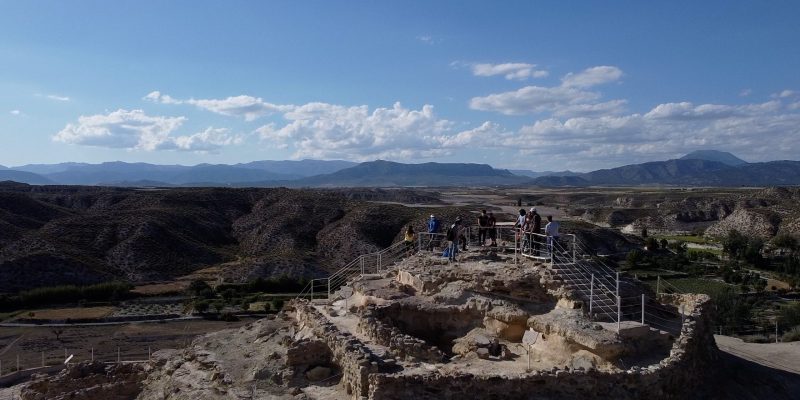
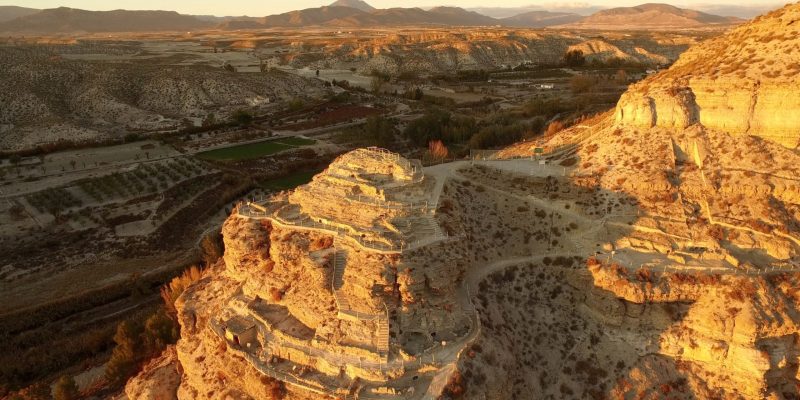
The Castellón Alto settlement is part of the El Argar Culture, during an advanced period of the Full Bronze Age, and is dated between 1900-1600 BC.
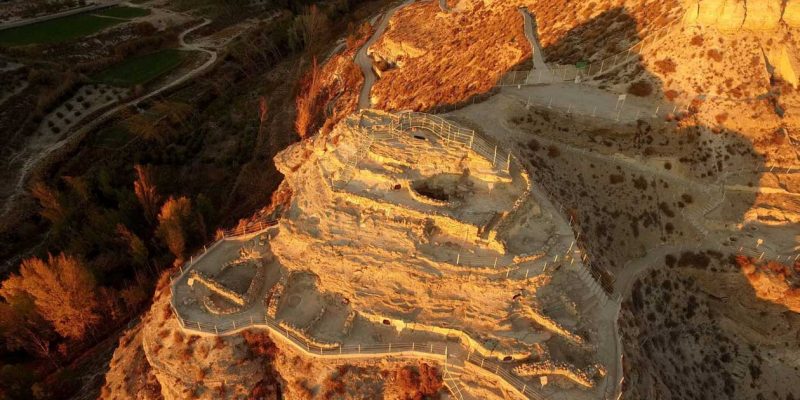
It consists of a habitat that is located in two large units connected to each other: the head or spur, with its three natural terraces where the houses are located, and the slope of the adjacent hill. The Upper Terrace is separated from the rest of the settlement by a perimeter wall, forming an acropolis area where the elite of the settlement lived, with fundamental elements for survival such as the Cistern or water tank.
It is worth mentioning the discovery of 130 burials inside the housing units; these, except for the child burials in urns, are found in artificial caves excavated in the rock, mostly sealed by large slabs.
The magnificent preservation of the archaeological record of Castellón Alto, especially of the organic remains, has allowed us to obtain an important knowledge of the environment of the time and its economic exploitation; allowing, the results obtained, to reconstruct the urbanism of this settlement and the daily life of its population.
In 2002, a burial site was found at the site with the remains of two partially mummified individuals, a child of about four years old and an adult who preserved remains of body tissues and locks of long dark hair on his head, which was combed with two side braids and a central ponytail.
In 2005 the site was awarded the National Prize for Conservation and Restoration of Cultural Heritage by the Ministry of Culture.